What is a Geyser?
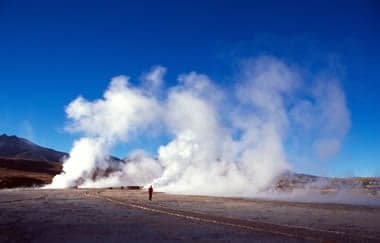
A geyser is a vent in Earth's surface that periodically ejects a column of hot water and steam. Even a small geyser is an amazing phenomenon; however, some geysers have eruptions that blast thousands of gallons of boiling-hot water up to a few hundred feet in the air.
Old Faithful is the world's best-known geyser. It is located in Yellowstone National Park (USA). Old Faithful erupts every 60 to 90 minutes and blasts a few thousand gallons of boiling-hot water between 100 and 200 feet into the air.
Conditions Required for a Geyser
Geysers are extremely rare features. They occur only where there is a coincidence of unusual conditions. Worldwide there are only about 1000 geysers, and most of those are located in Yellowstone National Park (USA). The conditions required include:
Hot rocks below
An ample groundwater source
A subsurface water reservoir
Fissures to deliver water to the surface
Where are Geysers Found?
Most of the world's geysers occur in just five countries: 1) the United States, 2) Russia, 3) Chile, 4) New Zealand, and 5) Iceland. All of these locations are where there is geologically recent volcanic activity and a source of hot rock below.
Which Geyser is the World's Largest?
The tallest active geyser in the world is Steamboat Geyser in Yellowstone National Park. Some of its eruptions blast water as high as 400 feet into the air. Waimangu Geyser in New Zealand used to be the tallest geyser in the world, blasting jets of water up to 1600 feet in the air, but it has not erupted since 1902.
How Do Geysers Work?
To understand how a geyser works, you must first understand the relationship between water and steam. Steam is produced when water is heated to its boiling point. When water converts into steam at surface conditions, it undergoes an enormous expansion because steam occupies 1600 times as much space as the original volume of water.
Cool groundwater near the surface percolates down into the earth. As it approaches a heat source below, it is steadily heated. Because it is deep below the ground, the weight of cooler water above produces a high confining pressure, creating "superheated" water. At some point the deep water becomes hot enough, or the confining pressure is reduced, and the frustrated water explodes into steam in an enormous expansion of volume. This "steam explosion" blasts the confining water out of the vent as a geyser.
Are There Geysers on Other Planets?
So far, geysers have not been discovered on other planets; however, geyser-like activity has been documented on some of the moons in our solar system. Jupiter's moon, Io, has eruptions of frozen water particles and other gases through vents in its surface. Triton, a moon of Neptune, and Enceladus, a moon of Saturn, also have these cold geysers sometimes called "cryovolcanoes."
Source Reference: Geology.com - What is a Geyser? by Hobart M. King, PhD (https://geology.com/articles/geyser.shtml)