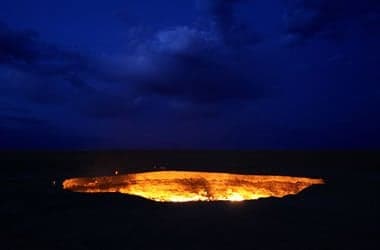
What is the Darvaza Gas Crater?
The Darvaza Gas Crater is a large crater in the Karakum Desert of north-central Turkmenistan where thousands of flames fueled by seeping natural gas have been burning for decades. The crater is about 226 feet (69 meters) across and about 98 feet (30 meters) deep. It has an area that would nearly cover ¾ of an American football field - including the end zones. The flaming crater's sights and sounds are frightening enough that local people call it the "Door to Hell" or the "Gates of Hell".
Each dancing flame marks the spot where natural gas (methane) emerges from the walls, from the floor, or from the talus piles within the crater. When the natural gas emerges, oxygen in the atmosphere causes it to burst into flames.
What Causes The Flames?
The flames are caused by natural gas seeping from the surrounding rock into the crater. The gas travels through joints (natural near-surface fractures), permeable rock units, and bedding plane separations. These delivery paths produce flames along the crater walls and send gas seeping through the talus pile. The result is thousands of small flames throughout the crater.
Natural Gas in Turkmenistan
The United States Energy Information Administration (EIA) reports that Turkmenistan had the world's sixth-largest natural gas resource in 2016 and was one of the world's top 15 natural gas producers in 2015.
How Did the Darvaza Gas Crater Form?
The Darvaza Gas Crater is reported to have formed in about 1971 while Soviet geologists were exploring for oil and natural gas. They began drilling and quickly realized that they had penetrated an underground cavern. Then the ground beneath their equipment began to subside. The crew managed to escape, but their equipment was lost in the collapse.
Geologists use the name "sinkhole" for this type of feature - formed when the ground surface sinks or collapses into a cavern. The author believes the Darvaza Gas Crater, along with nearby "Water" and "Mud" craters, are cover collapse sinkholes.
Cover Collapse Sinkhole
Cover collapse sinkholes generally form where a limestone rock unit at depth is being dissolved and removed by subsurface weathering and erosion. At first, cavities forming in the limestone are overlain by rock layers that are competent enough to support the ground surface. This unstable condition is temporary, and the overlying rock layers will eventually deteriorate and collapse into the voids below. The collapse can be triggered by continued subsurface erosion, an earthquake, vibrations, or, loading of the surface by rain water, construction, or a vehicle like a drilling rig.
Environmental Concerns
In January 2021, the Associated Press reported that Gurbanguly Berdymukhamedo, President of Turkmenistan, ordered the "Gates of Hell" fire extinguished because it causes ecological damage and affects the health of people living nearby.
Source Reference: Geology.com - Darvaza Gas Crater by Hobart M. King, PhD (https://geology.com/oil-and-gas/darvaza-gas-crater/)