Who was my co-op with?
I did my Earth Resource Technician (ERT, now Geological Technician) co-op with AMG Environmental Monitoring. My six-month co-op at AMG began on May 10th. AMG Environmental provides flow monitoring services for storm sewers, sanitary sewers and rivers. AMG also offers fire hydrant testing, smoke testing, rain gage monitoring, and water testing services. AMG has three offices located in Halifax, Nova Scotia; Mississauga, Ontario and Barrie, Ontario. The bulk of AMG Ontario’s work is municipality based spanning Niagara to Sudbury with some private sector monitoring in between.
How does AMG monitor flow?
AMG monitors flow in sewers by use of live feed flow monitoring equipment. The flow monitoring equipment includes a monitor that sends/receives and collects data, sensors that measure velocity of the flow and sensors that measure the depth of flow. With the two types of sensors, a volume of flow can be calculated and tracked in real-time for the client. The monitoring equipment is installed and maintained by AMG for their clients.
What was my position and responsibilities at AMG?
AMG has eight field crews that install and maintain the flow monitoring equipment and each crew is composed of a level one Environmental Flow Technician and a level two Environmental Flow Technician. The level one technician works up-top of the sewer, monitoring the safety outside the manhole, programming and sending/receiving data for Data Analysts who oversee the sites in each region.
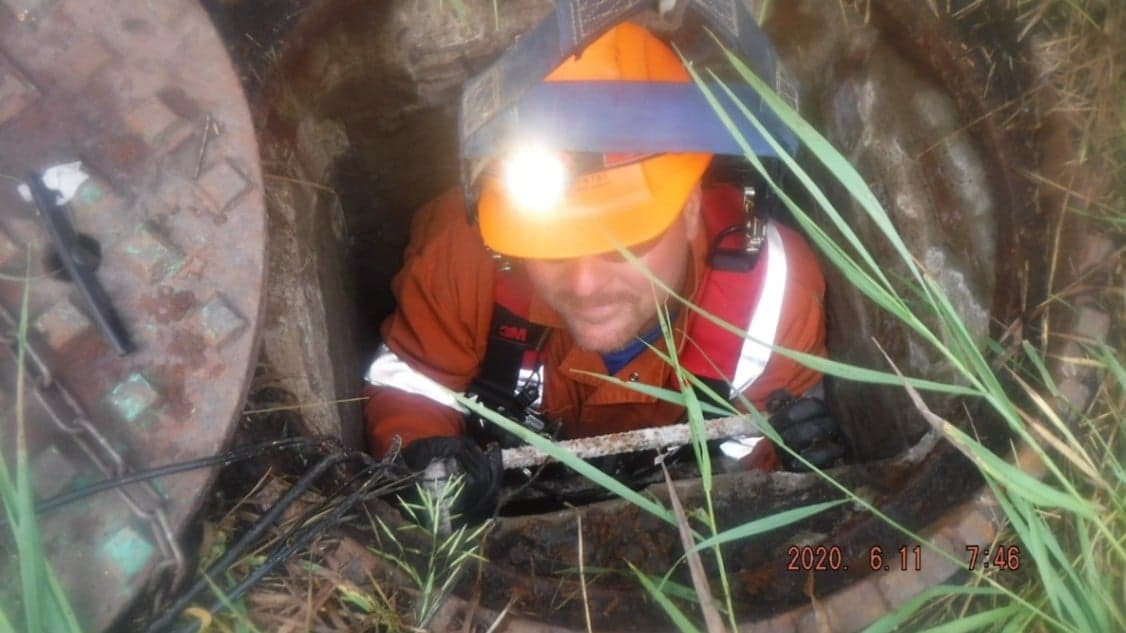
I was hired as a level two technician, and my responsibilities involved donning all required PPE and performing entries for each site installing equipment, calibrating sensors, fixing equipment, noting and resolving issues such as sensor fouling. The sensors accuracy drifts over time and verifications must be made frequently to ensure accurate data collection. Also, sensor fouling happens frequently. Fouling of the sensors is usually due to “ragging” or “silt”. “Silt depth” is always measured as it effects the sensor’s performance. “Silt equations” are used to compensate for the silt occurrence for calculating flow. I also installed rain gages atop roofs for monitoring precipitation. My miscellaneous responsibilities involved inventorying equipment, restocking supplies, and sanitizing the work van along with all tools and equipment used at the end of each shift.
What training is required for a level two Environmental Flow Technician?
The training for a level two technician that AMG provided included onsite and offsite training programs. On-site training programs included 40 hours of computer aided module training on working at heights, confined space awareness, traffic control, workplace violence and harassment, health and safety awareness, first aid, personal protective equipment (PPE) and WHMIS training. Off-site training included: a one-day course on working at heights training, a one-day course on confined space training, and a one-day course on level two first aid training. Following the completion of my safety training, I was supervised for one week on performing entries to sites to ensure that I was comfortable and competent with the level two technician job and responsibilities.
What a normal workday looked like.
I was required to work 10.5 hours per day, Monday to Thursday, and a normal workday as a level two technician began with my alarm going off at 3:45 am. Once arriving at the shop for a 6:00 am start time, I would begin my check lists which included a vehicle safety checklist and an equipment checklist. My level one technician partner would print out the work orders for the day and all required permits. Upon arrival at the first site, traffic controls would be setup, which included signage and safety cones. Once all traffic controls were in place, all PPE would be set up including a tripod with a winch, retractable lifeline, and safety cage. I would go through another safety checklist ensuring all PPE equipment is in good-condition and functioning correctly while my partner performed a pre-site hazard assessment. Entries would be completed throughout the day using various traffic control setups and safety assessments would be completed before each entry.
How you found this employment opportunity?
Though the job of a level one Environmental Flow Technician is tough, I found my co-op employment opportunity to be a good all-around experience. I come from a 14-year steel construction background and I found that my co-op experience had helped me learn to conduct myself more professionally by working in a formal setting and allowed me to experience a new industry within the environmental sector. AMG Environmental is an excellent employer with providing substantial training for the position I held and providing a friendly team oriented working environment.
What was your favorite part of the job?
My favorite part of my job was travelling around Ontario and seeing many communities and sights that I have never seen before. I also enjoyed servicing sites in private sector industries, such as breweries, distilleries, and wastewater treatment facilities. The aspect of my co-op that inspired me to pursue further study or practice, was working in a professional environment and being held accountable for my duties as a professional.
How do you feel co-op has added to your geoscience education?
I feel my co-op experience has added to my geoscience education in that my co-op exposed me to other aspects of hydrology and I have become versed with the various technologies used to monitor flow of various applications. I feel this knowledge will help me later with a potential career in resolving, assessing or monitoring environmental problems and issues.
What would you like to do once you have graduated?
Having already graduated from the three year Environmental Technology program and once I have graduated the ERT program, I would like to pursue a career that is meaningful, that makes a positive difference in the environmental field, that is interesting, as well as, engaging and is a professional designation.
Source Reference: Fleming College - Shawn Jensen – Environmental Flow Technician (https://wpflemingcollege.com/ertblog/2023/05/31/shawn-jensen-environmental-flow-technician/)